


Call For Papers

LARS 2025 will be a key event bringing together robotics experts, both researchers and professionals from Latin America and other regions. Held at the Tecnológico de Monterrey, the symposium will promote collaboration between academia, industry, and educational institutions, fostering the development of robotics applications in the region and their adoption by companies across diverse sectors. It also seeks to inspire young students to pursue careers in robotics, providing them with the necessary tools to contribute to technological advancements. We welcome submissions on the topics listed below. All submissions will be reviewed by the Program Committee.
Accepted papers will be published in the 2025 IEEE Latin American Robotics Symposium Proceedings, and authors will present their work during the event. The symposium will be conducted in a in-person format.
Research Topics
LARS 2025 will address key topics in robotics, providing a comprehensive overview focused on the needs of Latin America. Areas of interest include, but are not limited to:
- Autonomous Robotics: Autonomy and decision-making in robotic systems, with an emphasis on their integration into real-world environments (sensing, manipulation, navigation).
- Artificial Intelligence in Robotics: Use of AI to optimize interaction and decision-making, improving robot adaptation and efficiency.
- Robotics Systems for Industry 5.0: Transforming manufacturing through the integration of autonomous technologies into key industrial processes.
- Bio-Inspired Robotics: Innovations in autonomy based on mechanical, structural, and biological behavioral principles for application versatility and adaptability.
- Field and Service Robotics: Applications and new approaches for the preventive maintenance, data collection, and corrective actions in industrial and civil infrastructure settings, as well as open and unstructured outdoor settings for applications such as forestry and agriculture.
- Space Robotics: Ideas and proposals for exploring outer space, including other planets and natural satellites, as well as systems for providing monitoring, servicing and maintenance to artificial satellites, space stations and systems on the Earth.
- Educational Robotics: Innovations and applications of robotics-related technology for all education levels, as well as new approaches to teach robotics.
- Simulation and Digital Twins: Innovations and proposals for the creation of simulators for robotics, as well as the creation of digital twins applying robotics and other state-of-the-art technology.
- Emerging Technologies in Robotics: Latest advances in soft robotics, deep neural networks, advanced sensors, and other emerging technologies that expand the capabilities of robots in complex tasks.
We also welcome papers focusing on the following topics: Aerial Robots, Cognitive Robotics, Dynamics and Control, Embedded and Mobile Hardware, Evolutionary Robotics, Human-Robot Interaction and Interfaces, Humanoid Robots, Learning and Adaptation, Micro and Nano Robotics, Motion Planning, Multi-Robot and Multi-Agent Systems, Robot Competitions, Robot Modeling, Robot Perception, Robot Programming, Robotic Architectures and Middleware, Robotic Manipulators, Robotic surgery and rehabilitation, Robotic Swarms, Entertainment Robots, Search and Rescue Robots, Self-Localization, Mapping and Navigation, Sensor Modeling and Sensor Networks, Visualization and Monitoring, Underwater Robotic Systems, Vision in Robotics and Automation
Author Guidelines
- Submissions must be done electronically in PDF format via Microsoft CMT as stated below.
- All submissions must be in English.
- As indicated in the commitment statement undersigned when submitting your paper, the final version will fundamentally correspond in length and contents to the submitted version, except for parts that might be added or modified to comply with the reviewers’ suggestions. It is considered unethical to shorten or otherwise alter the final version in ways that make it weaker than what approved by the reviewers.
- For regular papers, the submission will be removed from the program and will NOT be submitted for consideration to the IEEE Xplore in the following cases:
- If none of the authors of an accepted paper are registered (fees and registration site will be announced soon).
- If none of the authors present the work in-person (15-minute oral presentation) at the LARS2025.
- For posters, the submission will be removed from the program in the following cases:
- If none of the authors of an accepted poster are registered (fees and registration site will be announced soon).
- If none of the authors present the work in-person (physical poster) at the LARS2025.
- For tutorials/short-courses, the submission will be removed from the program in the following cases:
- If none of the authors of an accepted proposal are registered (fees and registration site will be announced soon).
- If none of the authors attend in-person the proposed tutorial/short-course at the LARS2025.
- Please follow the “Instructions for Submission” and the corresponding guidelines below.
Instructions for Submission
- All authors must create a CMT account before trying to submit a paper or a poster.
- Here is a link to create the account: https://cmt3.research.microsoft.com/docs/help/general/account-creation.html
- Here is a link for authors on how to submit a paper/poster: https://cmt3.research.microsoft.com/docs/help/author/author-submission-form.html
- Please follow the guidelines provided below.
Submission of Regular Papers
- Papers must be written in English and must not exceed six (6) pages in standard IEEE-RAS format (https://ras.papercept.net/conferences/support/support.php), including title, abstract, tables, figures, and references.
- Papers should present new solid results in theoretical, empirical, and applied research related to the symposium topics.
- This year the reviewing process will be SINGLE BLINDED.
- To enter a submission, please click on the button below and follow the instructions provided.
Submission of Poster Presentations
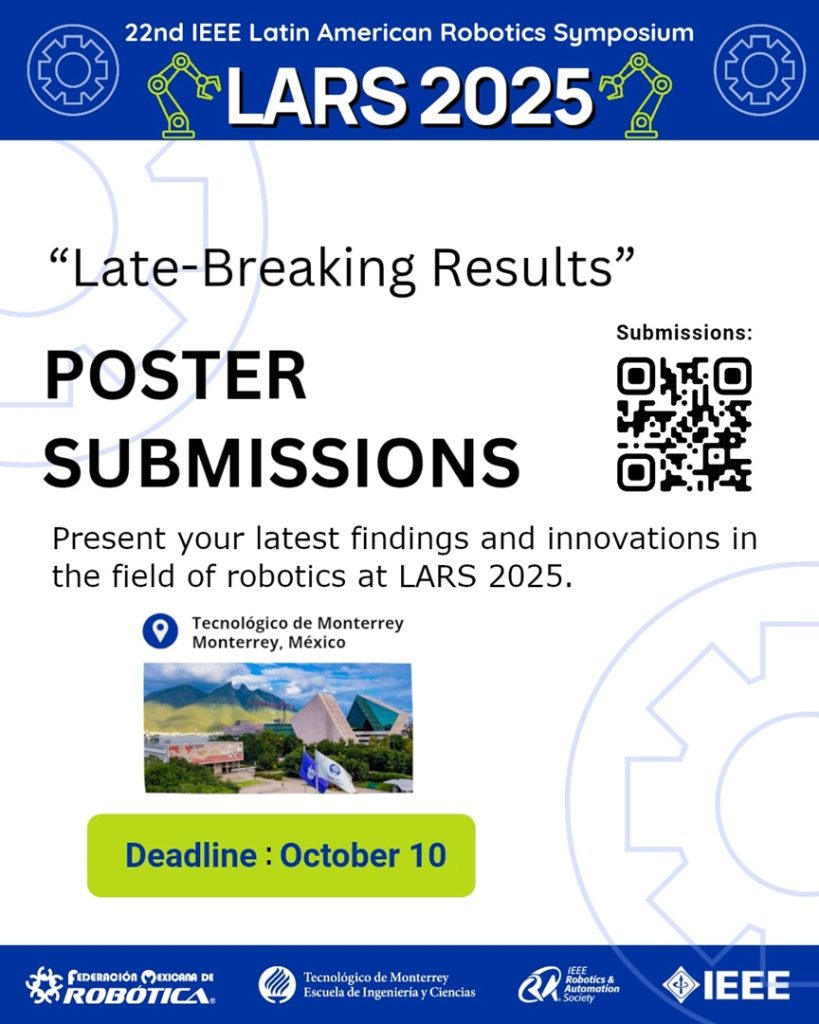
- We open the invitation to present your latest findings in the fields covered by this event by contributing to the LARS 2025 Poster Session. Please note that these contributions are not peer-reviewed and do not qualify as official publications, but they will be available to conference attendees in both poster and electronic form.
- This is a great opportunity to receive feedback on your work before submitting it for formal publication. A panel will review submissions for suitability and notify you of acceptance as soon as possible. If your poster is accepted, one of the authors must register for the conference and present their work at the poster session.
- A full registration to LARS 2025 is required.
- The authors are to include a short abstract of 1-2 paragraphs to summarize the poster in text along with the full poster.
- Poster and short abstract language: English.
- Poster size: The maximum dimension of the poster panel is 74” wide x 53” high (~1.8m wide x ~1.3m high) though we suggest not exceeding 60” wide x 40” high (1.5m wide x 1m high)
- File format: PDF (Please limit the size of the PDF file to 2 MB).
- Poster format (if accepted): Content printed by author on paper/cloth for presentation in the Poster Session
- There is no specific template for the posters. You should choose the format that best represents your research work. Please include the LARS 2025 logo in your poster (logo here)
Submission of Tutorials and Short-Courses
Proposals will be evaluated based on all information provided in these sections and decisions will be based on (i) the topic of the proposed event, (ii) the event’s format and the likelihood of creating an engaging intellectual environment, and (iii) the inclusiveness of the event.
We especially encourage proposals focused on the needs of the Latin American community, as well as proposals that promote collaboration between academia, industry, and educational institutions.
Proposals should be no more than 12 pages single-column (or 6 double-column) in PDF format and follow the provided template:
- Type and Duration: Specify whether you are submitting a tutorial or a short-course proposal and the intended duration.
- Provide a title for your event.
- Provide an affiliation, address, email address, and URL for each organizer. Indicate which organizer will be the primary contact person. All correspondence will be sent to this person, who will be expected to respond promptly.
- Please provide a URL to a live website with information about the proposed tutorial or short-course. The link should be included in the proposal.
- Please provide a short paragraph (200 WORDS MAXIMUM) describing the proposed event. This paragraph will be used to advertise the event on the LARS 2025 website.
- Describe your event in detail and how you will ensure the highest quality content such that attendees get the most out of the expected exchanges of ideas. The proposed tutorial/short-course will be evaluated in terms of the event’s suitability and its potential to engage participants with diverse thoughts and backgrounds.
- A description of the format of the tutorial/short-course (e.g., presentations, panels, breakout sessions, interactive activities) and how it will encourage discussion and participation. Highlight any novel aspects of the format and explicitly state whether people who are unable to travel to the conference will be able to participate and how (Zoom session? streaming talks + Q&A? etc.). Please also provide information regarding 1) previous experience on offering a tutorial with the same topic or similar, 2) target audience in terms of the level of expertise or the must-have-background.
- A tentative schedule and, if the tutorial/short-course includes invited speakers, a list of confirmed speakers and a description of your efforts to include speakers from a diversity of demographics, geographic locations, and career stages. It is strongly recommended to include an appendix with an email from each speaker that confirms their intended participation and gives a tentative title of their talk.
- Plan to solicit participation: Please describe (500 WORDS MAXIMUM) how you plan to solicit participation in your event if it is accepted. How do you plan to attract researchers with relevant expertise to attend the event? Steps that go beyond an email to robotics-worldwide are encouraged. If you have organized similar events in the past, estimate the number of participants that you expect. List the titles, organizers, and URLs of the previous events.
- Plan to encourage interaction among participants: Describe (500 WORDS MAXIMUM) what steps you will take to encourage interaction among participants. Tutorial proposals that have the potential to increase the number and diversity of participants, encourage participants to stay for the full duration of the event, and promote interaction will be given preference.
- Describe (500 WORDS MAXIMUM) a dissemination plan for the tutorial materials and outcomes. Creating an accessible online archive for media, articles, and discussions is strongly encouraged. Please describe the process and how access will be provided to participants and LARS 2025 attendees. Strategies for reaching a broad audience, including researchers from traditionally underrepresented backgrounds, will be viewed as a particular strength.
- Plan to improve diversity and inclusion: Describe (500 WORDS MAXIMUM) the steps you will take to enhance diversity and inclusion among participants. Outline your plans to ensure diverse and inclusive participation and interaction beyond invited talks and poster sessions. Proposals that show strong potential to increase participant diversity, promote inclusive engagement throughout the event, and foster meaningful interactions among a varied group of attendees will be given preference.
- Compliance with RAS Guidelines for Tutorial Organizers: Please include a statement confirming that the organizers will be present at the tutorial/short-course and that the tutorial/short-course will comply with the RAS Guidelines (please note that the recommendation letter from a “RAS Technical Committee” is desired, but not compulsory for this event).
- A statement that the tutorial/short-course organizers have read and will abide by the IEEE RAS Code of Conduct.
- (Optional) Equipment: A computer projector and screen will be provided. List any other required equipment that the LARS 2025 organizers might be able to provide.
Important Dates
Regular Papers:
Submission site opens: June 21th, 2025
Submission deadline: July 21st, 2025 August 4th, 2025 August 22nd, 2025 (Hard deadline)
Notice of Acceptance: Sept. 1st, 2025 September 14th, 2025 September 22nd, 2025
Registration and Camera-Ready Submission deadline: Sept. 29th, 2025 October 6th, 2025 October 8th, 2025
Poster Presentations:
Submission site opens: June 21th, 2025
Submission deadline: August 15th, 2025 September 5th, 2025 (Hard deadline)
Notice of Acceptance: September 15th, 2025 September 29th, 2025
Registration and Camera-Ready Submission deadline: Sept. 29th, 2025 October 6th, 2025 October 8th, 2025
Tutorials and Short-Courses:
Submission site opens: June 21th, 2025
Proposal submission deadline: July 18th, 2025 August 4th, 2025 August 22nd, 2025 (Hard deadline)
Notice of Acceptance: August 15th, 2025 August 25th, 2025 September 1st, 2025
Participation to the event:
Deadline for author registration: Sept. 29th, 2025 October 6th, 2025 October 8th, 2025
LARS paper presentations: October 29th to November 1st, 2025
LARS poster presentations: October 29th to November 1st, 2025
Tutorials and short-courses: October 29th and November 1st, 2025
Contact
For any inquiries regarding the call for papers and the submission process, please contact: lars.2025.itesm@gmail.com
Registration
Registration site will be provided at a later date.
“The Microsoft CMT service was used for managing the peer-reviewing process for this conference. This service was provided for free by Microsoft and they bore all expenses, including costs for Azure cloud services as well as for software development and support.”